





It typically takes a long time for the law to catch up to technology, especially in the copyright industries.
Since OpenAI launched ChatGPT in November 2022, dozens of lawsuits have been filed against generative AI companies, alleging infringement. A handful of bills directed to the use of copyrighted material in generative AI are being advanced through Congress. Countless stakeholders – including creators, companies, and investors – are wondering how long it will take for the law surrounding copyright and generative AI to settle through a combination of court decisions and legislative action.
One way to help predict the time that will elapse until copyright law settles in response to generative AI is to examine how long it took to settle around previous disruptive technologies. If the past is any guide, it could be several years before the relevant law settles. And this could have implications for a wide range of businesses whose revenue models or funding are predicated on clarity in copyright law.
This article provides a brief survey of seven technologies that disrupted copyright industries since the late 19th century. For each such technology, I describe how it was invented and when the pieces came into place for it to become a mass medium. Then I discuss the novel copyright issues that the technology introduced and how the law adapted to address those issues. I compare the timelines for each of these technologies and examine how they changed over time. The bottom line is that while it is taking less and less time for the law to settle around new technologies, that timeline is still many years long.
Phonograph Records
Thomas Edison invented a machine that recorded sound onto a cylinder in 1877. By 1901 he had developed a process for manufacturing the cylinders at scale. Emile Berliner invented the disc-based gramophone and formed the Victor Talking Machine Company, also in 1901. Despite its inferior sound quality, Berliner’s disc eventually beat out Edison’s cylinder among consumers because it was easier to use and store on shelves.
After World War II, Columbia and RCA Records created the 12-inch LP and 7-inch 45 rpm single, respectively. These formats led recorded music to become a multi-billion-dollar industry by the 1970s and persist essentially unchanged to this day.
The copyright conundrum associated with sound recordings is simple: should they get copyright protection? The question of copyrightability of sound recordings persisted for decades through myriad litigations and attempted legislation. The primary opponent was the broadcasting industry: radio stations objected to paying royalties for airplay of records.
In the late 1960s, record labels began to worry about the growing number of bootleg recordings. They worked out a compromise with the broadcasting industry in which sound recordings would get copyright protection for reproduction and distribution, but not public performance. In the U.S., this was enacted in the Sound Recording Act of 1971, although only for sound recordings made after it took effect in 1972. Notwithstanding the limitations of the 1971 Act, some of which were addressed later on (as we’ll see), it’s fair to say that U.S. copyright law settled around sound recordings in 1971, 70 years after Edison and Berliner’s sound recording technologies.
Radio
The first licensed radio broadcast to the public occurred in 1920 on KDKA in Pittsburgh, PA. Radio became a mass medium for musical artists starting in 1924 when AT&T built the first nationwide broadcast network, the National Broadcasting System (later NBC). The invention that brought radio fully into the sphere of the recorded music industry was the transistor radio, introduced in the mid-1950s. Electronics makers in postwar Japan introduced cheaper models that teenagers could afford.
With the rise of digital networks in the 1990s, streaming technology was invented, creating a digital emulation of radio signals. Many AM/FM broadcasters began streaming their signals online, and various “pure play” digital radio services emerged. These led to services like SiriusXM satellite radio and Pandora that are popular today.
Copyright questions around radio included: did broadcasts of live music invoke any of the exclusive rights in copyright law? Was advance permission required to broadcast a musical work? And what rights on recorded music, if any, applied?
The United States Court of Appeals for the Sixth Circuit resolved the first of these questions in Remick v. American Automobile Accessories in 1925 by holding that a public performance of a musical work need not be to an audience gathered in one place. ASCAP and BMI were established as performance rights organizations (PROs), to create blanket public performance licenses to musical works, including licenses for radio broadcasters.
Yet these licenses covered musical compositions, not sound recordings. The 1971 Sound Recording Act didn’t include performance rights in sound recordings, so radio broadcasts of recorded music didn’t get copyright protection and thus didn’t generate royalty payments. In 1995, the Digital Performance Rights in Sound Recordings Act (DPRA) conferred those rights on digital radio services such as SiriusXM, Pandora, and the Internet streams of AM/FM stations. As a result, these services do pay royalties to record labels and artists. The Music Modernization Act of 2018 partially closed the performance rights loophole in sound recordings by making copyrights in sound recordings retroactive to before 1972, but only for digital radio; it didn’t establish copyright protection for AM/FM broadcasts of recordings.
This is unlikely to change in the foreseeable future. Still, digital services account for the majority of radio listening today. Therefore, from the first nationwide radio network in 1924 to the DPRA of 1995, we can say that the time it took for copyright law to settle around radio broadcasting was 71 years.
Photoreprography
Chester Carlson invented the process that came to be known as xerography in 1938. The Haloid Company licensed Carlson’s technology and created the first production xerography machine, the Haloid 914, which appeared in 1959. By 1962, 10,000 machines had been shipped to customers and the company had renamed itself Xerox.
The business exploded: by 1966, Xerox estimated that Americans were making 14 billion copies per year on millions of machines. Once Xerox’s core patents had expired in the mid-1970s, other companies like IBM, HP, and Japanese makers such as Canon, Konica, and Ricoh, entered the photocopying business. Prices decreased, color and duplex copying were introduced, speeds increased, and form factors became smaller.
Copyright challenges were inevitable as the machines proliferated. The first important case to be brought was Williams & Wilkins Co. v. United States, first filed in 1968. The medical publisher Williams & Wilkins accused the National Institutes of Health and the National Library of Medicine of infringing its copyrights by making unauthorized photocopies of articles from the publisher’s journals. The court held that the photocopying was fair use because it was for non-profit scientific research.
At this time, Congress was preparing to enact a major revision of U.S. copyright law. No provision about photocopying made it into the 1976 Act, but Congress recommended that publishers “work out means by which permissions for uses beyond fair use can be obtained easily, quickly, and at reasonable fees.”[1] As a result, some publishers and copyright users created the Copyright Clearance Center (CCC) to offer licenses to companies covering a large body of content, principally from scientific and technical journals. CCC began operating in 1978, just as the 1976 Act went into effect.
Some companies subscribed to CCC’s blanket license, while others argued that photocopying was fair use. In 1985, a group of scientific journal publishers brought a case against Texaco, one of the latter companies. The case, American Geophysical Union et al v. Texaco, ended up in the Second Circuit appeals court, which in 1995 ruled for the publishers. The court’s opinion cited the availability of CCC’s blanket license as a factor in its determination that Texaco employees’ photocopying was not fair use. As a result, many more companies took what is now known as CCC’s Annual Copyright License (ACL).
Taken together, these cases provide guidelines for photocopying of copyrighted material. In all, the time lag from the introduction of the Haloid 914 in 1959 to the Second Circuit decision in Texaco in 1995 was 36 years.
Home Taping
The German electric company AEG demonstrated the first production tape recorder, the Magnetophon, in 1935. In the aftermath of World War II, U.S. Army Major Jack Mullin discovered Magnetophon tape machines in German radio studios, retrieved them, and adapted them for American use. These machines used open-reel tape, which was bulky and not easy to handle.
Cartridge formats made tape more compact and easier to use. The first cartridge format designed for music was the Stereo-Pak, a variation of the Fidelipac “cart” format used in radio stations, introduced in 1962. Bill Lear created the Stereo-8 cartridge format, later known as the 8-track, in 1965 for music playback in his Lear Jets. Lear made deals with several automakers to have these units factory-installed in cars, which helped 8-tracks prevail over Stereo-Paks by the end of the 1960s.
But the Compact Cassette is the tape format that became the most popular. Philips Electronics of the Netherlands launched it in 1963 as a pocket-sized medium for voice and other personal uses. Its use as a mass-market format for home music taping effectively began in 1966, when Philips released the first combination radio/cassette machine (which could record music off the air) and record labels started releasing albums on cassette. Cassette decks that could be used with home stereos to record LPs appeared in the late 1960s.
Dolby noise reduction and DuPont’s chromium dioxide tape formulation came together in the early 1970s to enable high-fidelity music reproduction on cassettes. Home taping grew in the 1970s as better sound quality filtered down from audiophile to moderately-priced home cassette decks; cassettes overtook 8-tracks and then exceeded vinyl as the most lucrative recorded music format from 1984 until compact discs (CDs) surpassed them in 1990.
The copyright concern around tape formats was obvious: what to do about unauthorized copies of commercial music releases that people were making at home? These copies were infringements.
One particular use case, home taping of broadcasts, wound up in court in the context of videocassettes. In 1975, Sony released the first successful home videocassette recording technology, the Betamax system. In 1978, a group of Hollywood movie studios sued Sony over taping from broadcast television. The result was the landmark 1984 Sony v. Universal Supreme Court decision, which held—among many other things—that use of the Betamax machine for home taping of broadcast material for personal replay (known as “time shifting”) was fair use.
The rapid rise of CDs in the 1980s and 1990s rendered cassettes largely irrelevant to the music industry; revenue from cassettes leveled off at the outset of the 1990s and then plummeted. Thus, the last word in copyright law on home taping was Sony v. Universal in 1984. This puts the length of time between the emergence of cassettes as a mass-market music format in 1966 and that decision at 18 years.
Digital Files
Digital audio started to be used in recording studios in the late 1970s. Karlheinz Brandenburger, a psychoacoustics researcher in Germany, invented a method of compressing digital audio files to 15-25% of their size so that they could be transmitted over the digital networks that were common in the early 1990s. The resulting codec (compression-decompression scheme) was standardized as MPEG-1 Layer 3, commonly referred to as MP3.
In July 1999, Shawn Fanning and Sean Parker created Napster, a software application that facilitated easy sharing of MP3s over the Internet without the knowledge of network protocols and other technical details that previous methods required. It spread like wildfire on college campuses (such as Fanning’s Northeastern University), with their potent combinations of high-speed networks and students who were passionate about music but short on cash. The recording industry sued Napster in December of that year.
Meanwhile, other entrepreneurs built servers that hosted MP3 files and enabled artists to sell them. One of these was Michael Robertson and his MP3.com website. In 2000, MP3.com introduced a feature called My.MP3.com, which allowed users to register CDs they owned, create MP3 files from them, upload the files to the site, and play them from there. This drew a lawsuit from Universal Music Group one month after the Napster lawsuit was filed.
MP3.com was found liable in April 2001; two months later, the Second Circuit Court of Appeals affirmed a district court decision that found Napster liable and ordered it to shut down.
Record labels gradually began to license content to file download services. In 2003, Apple’s Steve Jobs convinced the major labels to license their catalogs and launched the iTunes Music Store, which sold licensed digital song files for $0.99 each. This marked the beginning of a robust market for licensed music downloads, which helped to pull the music industry out of the nosedive that started after the launch of Napster.
Meanwhile, Michael Robertson returned in 2005 with a new service called MP3Tunes. This included a feature that enabled users to upload their music files to Internet servers and then to download them onto other devices they owned. Various other services adopted Robertson’s scheme, which came to be known as “cloud locker” or “cloud sync.”
The major issue of copyright law that digital file downloads raised was this: how culpable is an online service provider for any infringing actions taken by its users with digital files that the online service stores or helps copy and distribute, including copies users make for their own personal use?
This legal question, known as secondary or platform liability, had been raised in previous cases such as Religious Technology Center v. Netcom On-Line Communication Services in 1995. This helped lead to the Digital Millennium Copyright Act (DMCA) of 1998, which established limitations of liability (safe harbors) for certain types of online services from the infringing actions of their users under certain conditions.
Both Napster and MP3.com were found secondarily liable. The main source of Napster’s liability was its central server. In the years following Napster’s shutdown, entrepreneurs developed file-sharing technologies that operated without a central server; instead, information about file locations was distributed across users’ machines throughout the network.
The moment of major change was the Supreme Court’s 2005 decision in MGM v. Grokster, in which Justice David Souter found the file-sharing network Grokster liable for “inducing” copyright infringement (borrowing a legal theory from patent law) rather than because they operated central servers. This led most other file-sharing services to shut down.
Meanwhile, by the early 2010s, Amazon, Apple, and Google had all introduced cloud locker features, of the type pioneered by MP3Tunes, for users of their digital music services. Only Apple had taken a license for that feature. The question then was whether Amazon and Google (and others) needed one too.
Capitol Records filed suit against MP3Tunes in 2007 over several of its features, including cloud locker. In 2011, Judge William Pauley issued a summary judgment decision holding that the cloud locker feature qualified for safe harbor under the DMCA. As a result, Google, Amazon, and others could safely offer cloud locker functionality without an additional license for that feature.
This decision settled the law in the United States around digital files in the ways that people used most commonly. Therefore, the timeline for copyright law to settle around file-sharing since the launch of Napster in 1999 was 12 years.
Interactive Streaming
Interactive streaming services enable users to select music or video from a large online catalog and play it instantly. The idea of a “celestial jukebox” was first conceptualized in the mid-1990s, but the technology was not yet ready. The first such service to achieve full major label licensing was Rhapsody, from the startup Listen.com, which launched in late 2001 and achieved full major label licensing in July 2002 – a year before Apple launched the iTunes Music Store. Yet the service was not very popular for the first few years.
It took two later innovations to put interactive streaming on a path to market dominance: smartphones with apps, starting with the iPhone in 2007, and mobile broadband telecommunications, which the major mobile operators built out nationwide by the end of the 2000s. Interactive streaming exploded in popularity after 2011, when Spotify entered the U.S. market following a few successful years in Europe. Today, interactive streaming is by far the dominant mode of music consumption.
The primary copyright issue posed by streaming concerned payments of mechanical royalties to music publishers and songwriters for the compositions performed on recordings. Labels had handled payments of mechanicals for physical media and downloads, but they didn’t handle them for streaming. The metadata they send to streaming services typically does not include information about composition rightsholders. So streaming services had to hire agencies to figure this out after the fact. This led to errors and omissions in mechanical royalty payments– which in turn led to several lawsuits claiming large damages.
Music publishers and streaming services proposed a legislative solution: instead of each streaming service having to process its own mechanical royalties, a single nonprofit organization appointed by the U.S. Copyright Office would handle it for all participating streaming services. This was passed as the Music Modernization Act (MMA) of 2018, which went into effect in 2021. The nonprofit Mechanical Licensing Collective is funded by the streaming services and handles their royalty payments for streaming mechanicals. Thus, the timeline for the law settling around interactive streaming was 17 years, from Rhapsody’s launch in 2001 to the passage of the MMA.
Cloud Services with User-Uploaded Content
By the mid-2000s, high-speed Internet connectivity was on its way to being available throughout the United States, so entrepreneurs started to build content-sharing services for a type of digital content that would make use of all that bandwidth: video. Several entrepreneurs built startups that enabled users to upload videos to Internet servers, where anyone – not just the users who uploaded them – could find and stream them. The resounding winner of the resulting horse race was YouTube, which launched at the end of 2005.
The core issue for these types of services, as with digital files, is how much responsibility online service providers have for the copyrighted content that users upload to them. YouTube made deals with major record labels, television networks, film studios, and other rightsholders, in which they would provide their content to YouTube, enabling it to identify the content that users were uploading and target ads to users’ views of that content. In return, rightsholders would receive a share of the additional ad revenue as royalties. Yet the position that YouTube and others took was that this was merely a business arrangement, they had no legal obligation to monitor user uploads, and their copyright liability was limited under the DMCA.
The last significant court case on the subject was Viacom v. YouTube. The entertainment company (parent company of Paramount Pictures, MTV, and Nickelodeon) sued in 2007. Viacom appealed the case to the Second Circuit. The Second Circuit remanded it back to the district court, which in 2013 held that YouTube qualified for safe harbor under the DMCA. The case was settled before trial.
YouTube pays royalties to rightsholders that are much less than those paid by subscription services like Spotify, Apple Music, Netflix, and Hulu. While the Viacom case was making its way through the courts, the content industries made various attempts to get Congress to change the law so that online service providers had more responsibility for policing users’ uploads of copyrighted material; none of these succeeded. The content industry trade groups subsequently shifted focus on this issue from the United States to the European Union (resulting in the EU Directive on Copyright in the Digital Single Market of 2019).
This makes the timeline from YouTube’s launch in 2005 to the 2013 district court holding in Viacom v. YouTube a total of 8 years.
Conclusion
The following table summarizes the disruptive technologies discussed here and the timelines to the settlement of copyright law around them. It shows that the law took less time to settle during the heyday of consumer electronics and analog media than it did with the phonograph and radio technologies that first appeared before consumer electronics were widespread, and that it took less time to settle during the digital age than during the age of analog consumer electronics.
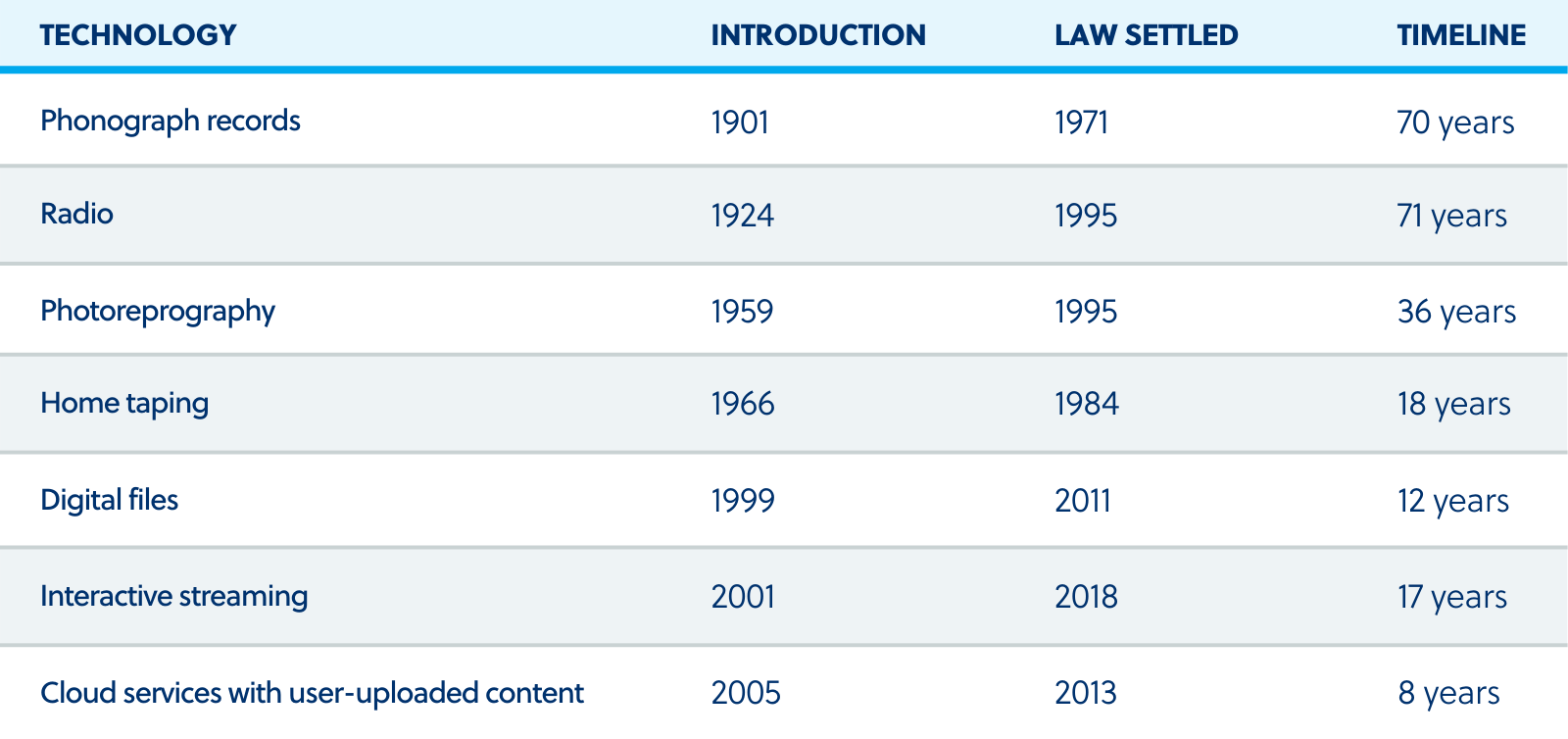
Meanwhile, it has been three years since the first copyright lawsuits were filed against generative AI companies. History tells us that we have years yet to go before copyright law settles around this newest disruptive technology.
[1] Copyright law revision : report (to accompany H.R. 2512), 1966. (Full text not available online.)