




Artificial Intelligence (AI) tools are transforming how research gets done. A study by Wiley last year involving more than 2,400 researchers worldwide found that 84% used AI tools in 2025, and 62% used AI for research and publication work.
In life sciences and pharmaceutical industries, scientists are using AI across the research pipeline. Applications from drug discovery and development to post market surveillance are helping to accelerate everything from target identification to trial design and medical communication.
In chemistry, researchers are using AI to identify and conceive new molecule candidates with desired characteristics and properties, to design and formulate new compounds and processes, and to reduce the environmental impact of existing processes and products.
Across disciplines and industries, AI has the potential to increase efficiency and productivity by helping to plan experiments, organize and interpret documentation and data, and draft reports.
The Hidden Challenge: AI, Copyright, and Data Integrity
Crucially, the accuracy and trustworthiness of any AI tool’s output hinges on its ability to draw on data from high-quality, reliable sources. In scientific research, that means peer‑reviewed articles, published books, database contents, regulatory submissions, proprietary datasets, and patents—sources that are commonly protected by copyright or other intellectual property (IP) rights. Just because a human can access content or data themselves online doesn’t automatically mean use in AI systems is allowed.
Responsible companies know that sustainable innovation must be rooted in a culture of using data in a compliant way that respects the copyright and intellectual property rights of others. For researchers, regardless of the tools they use, respecting IP is a matter of scientific integrity. Recognizing the contributions of other knowledge creators is as important as gaining recognition for their own discoveries.
The conundrum for many companies is how to facilitate their researchers’ use of AI tools to power innovation while respecting copyright and IP and making it easy for researchers to understand what they’re allowed to do with published literature.
To help bridge AI copyright compliance with innovation, CCC offers RightFind Suite. The set of integrated software solutions empowers researchers to access and manage scientific content quickly and easily while simplifying copyright compliance by putting rights information at their fingertips.
Expanded AI Use Visualization in RightFind Suite
Building on our years of experience designing solutions with copyright compliance in mind, the March 2026 release of RightFind Suite makes it even easier for researchers to check rights information on AI uses allowed under their organization’s copyright license(s).
Firstly, we are adding more examples of the types of internal AI use that are covered by CCC licenses, such as the Annual Copyright License, Multinational Copyright License, and the VG-WORT and JAC Digital Copyright Licenses.
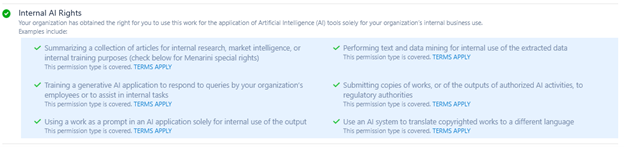
More examples mean it is easier than ever for researchers to understand what they can do compliantly with scientific literature. And, as ever, RightFind users can look up rights information at the click of a button before, during, and after acquiring content so they can easily see what is allowed.
Secondly, we are making it even easier to show AI rights and permissions covered by companies’ own direct agreements with publishers with an additional custom rights configuration capability, whether those rights are the same, similar, or different from the coverage CCC’s licenses offer.
Bringing together AI rights information from licenses and direct agreements, in conjunction with wealth of information on other rights for reuse, means that, in RightFind Suite, researchers have a one-stop-shop for accessing their licensed content and seeing an easy-to-understand summary of what they can do with it compliantly.
To learn more about the integrated, copyright-aware software solutions from CCC that help professionals search for, access, share, organize, collaborate on, and analyze content, visit the RightFind Suite page or reach out to the CCC team.
Resources for Responsible AI Policies If you are looking for information on how your company can use AI responsibly, check out A Corporate Copyright Policy Guide for Navigating the New AI Era. The CCC guide contains valuable information about using copyrighted materials with AI systems, as well as tips and questions to consider when developing policies for the responsible use of AI tools.